LONGi · Air cooling · Schrank
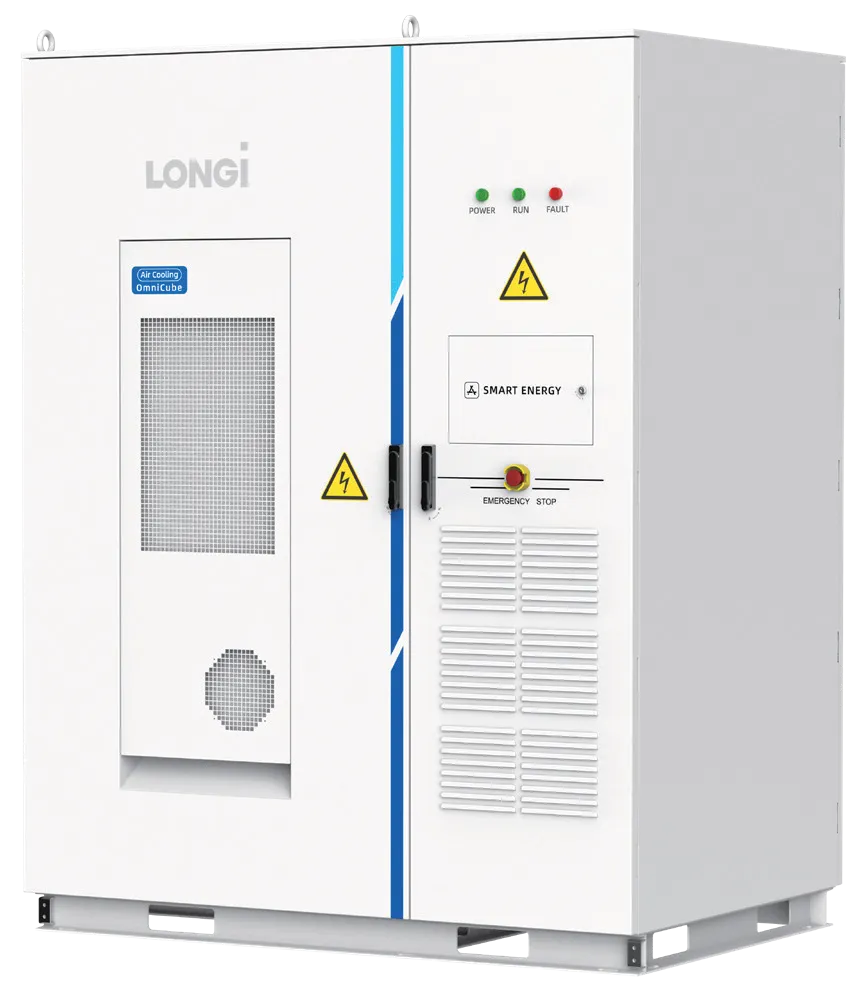
LONGi OmniCube A215
Integrated DC flexibility system for commerce and industry: 215 kWh, 105 kW, optional STS for grid/island operation and direct PV connection via MPPT.
Technical data
| System | |
|---|---|
| Nominal capacity | 215 kWh |
| Cell type | LFP 280 Ah |
| Cooling | Air cooling |
| Form factor | Schrank |
| Grid & power | |
| AC power | 105 kW |
| Grid voltage | 400 V |
| On/off-grid switching | Yes |
| Direct PV input | Yes |
| Installation | |
| Dimensions (W×D×H) | 1750×1215×2340 mm |
| Weight | 2.8 t |
| IP rating | IP54 |
| Fire protection | Aerosol |
Technical data per the manufacturer's datasheet; binding values depend on configuration and project.
OmniCube A215 — the 215 kWh commercial storage system for PV, load peaks, e-mobility and backup power
The OmniCube A215 is the central featured product of SpeicherCampus. It is not a simple battery cabinet, but a professional all-in-one energy system for commerce, agriculture, industry and larger PV installations.
In our OmniCube systems, the decisive functions are already integrated: 215 kWh of LFP storage, 105 kW of power, STS, a transfer time of under 20 ms, MPPT up to 50 kW, a complete EMS and Modbus controllability. This allows the A215 to cover several tasks at once: PV self-consumption, peak shaving, e-mobility, grid connection relief and backup power for defined loads.
Why the OmniCube A215?
Many storage systems are sold on capacity alone. For commerce, agriculture and industry that is not enough. What matters is whether the system can deliver power fast enough, works together with PV, reduces load peaks, can be controlled externally, and keeps defined loads running during a grid outage.
The OmniCube A215 connects storage, PV, grid, loads and control in a single system. That makes it more than a self-consumption solution — it is a technical platform for modern energy infrastructure.
The key advantages
All-in-one instead of a component puzzle
The A215 combines battery, PCS, EMS, STS, MPPT, BMS, remote monitoring and communication interfaces. This reduces interface risks and simplifies planning, commissioning and operation.
Integrated STS — transfer time under 20 ms
Not every storage system is a backup power system. In our OmniCube A215 systems the STS is integrated, with a transfer time of under 20 ms. This is particularly interesting for critical loads such as control systems, IT, refrigeration, gates, security systems, agricultural equipment and defined backup circuits.
Important: even with an STS, every backup power project needs proper planning. Grid disconnection, protection systems, load assignment, inrush currents and bridging time must be verified per project.
MPPT up to 50 kW integrated
The OmniCube A215 can connect up to 50 kW of DC PV directly via the integrated MPPT. New PV strings or targeted expansions can be tightly coupled to the storage system. Existing AC PV systems are integrated on the AC side via the shared bus.
A complete EMS
A storage system without a good EMS is just a big battery. The EMS decides when to charge, discharge, limit, reserve or prioritize. In the A215, the EMS controls PV, storage, grid and loads, enabling operating modes for self-consumption, peak shaving, e-mobility and backup power reserve.
Modbus controllability
Modbus makes the system integrable. The OmniCube A215 can be embedded in external energy management systems, charging infrastructure, building management systems or higher-level controls. That is decisive for professional commercial projects and future applications such as dynamic tariffs or aggregator models.
Key technical data
| Characteristic | OmniCube A215 |
|---|---|
| Battery capacity | 215.04 kWh |
| Cell chemistry | LFP |
| AC power | 105 kW |
| Grid voltage | 400 V AC |
| MPPT | integrated, up to 50 kW |
| STS | integrated |
| Transfer time | under 20 ms |
| Communication | RS485 / Ethernet |
| Protocols | Modbus, IEC61850, IEC104 |
| Cooling | air cooling |
| IP rating | IP54 |
| Fire protection | aerosol, to be assessed per project |
| Expandability | multiple systems in parallel |
Typical applications
Increasing PV self-consumption
The system absorbs PV surpluses and makes them available later during operation. This is strongest with low feed-in tariffs, high electricity purchase prices and regular consumption outside PV generation hours.
Peak shaving
With 105 kW of power, the A215 can absorb many typical commercial and agricultural load peaks. The load profile is decisive: duration, height and frequency of the peaks determine the required storage power and capacity.
E-mobility
EV charging stations create high load peaks. The OmniCube can buffer charging power, make PV power usable for vehicles and relieve the grid connection.
Backup power
With its STS, island-mode capability and sufficient power, the A215 is well suited to defined backup power concepts. Which loads can keep running must be planned in advance.
Agriculture
Agricultural businesses often have PV potential, refrigeration, ventilation, milking systems, pumps, workshops and growing e-mobility. That is exactly where the A215 can combine several benefits.
Who is the OmniCube A215 ideal for?
- commercial businesses with a PV system
- agricultural businesses with critical loads
- businesses with relevant load peaks
- companies planning charging infrastructure
- sites with a limited grid connection
- customers with backup power requirements
- projects with Modbus or EMS requirements
- businesses that want to expand later
Who is the OmniCube A215 not ideal for?
- typical single-family homes
- very small PV systems
- customers without a load profile or use case
- pure lowest-price comparisons by price per kWh
- projects that clearly belong in the MWh container class
- customers who set liquid cooling as a hard requirement
FAQ
Is the OmniCube A215 an emergency power system?
It is very interesting for backup power concepts because the STS is integrated and the transfer time is under 20 ms. Whether a specific load keeps running, however, depends on the backup circuit, the protection concept, inrush currents and the installation.
Can PV be connected directly?
Yes — DC PV up to 50 kW via the integrated MPPT. Existing AC PV systems are integrated on the AC side.
Is the system Modbus-controllable?
Yes. That is one of its most important advantages for professional applications.
Is air cooling a disadvantage?
Not as a general rule. For many commercial and agricultural applications, air cooling is robust, simple and economical. For high continuous loads or very high cycle counts, liquid-cooled alternatives can make sense.